
Volunteering at a Local Animal Shelter
A Meaningful Path to Understanding Companion, Therapy, and Service Dogs
Jeff Davis | https://rescuedogcentral.com
 0
0 0
0 0
0 0
0 0
0
If you want to learn dogs in a way that goes deeper than reading breed charts or watching a few training videos, spend time at a local animal shelter. That is where the polished ideas get stripped away and the truth of canine behavior stands in plain sight. You see fear, resilience, excitement, confusion, trust, and loyalty all packed into one kennel row. For folks interested in companion dogs, therapy dogs, or service dogs, there may be no better classroom.
I have spent enough time around working animals to know that you do not really understand one until you have seen it under pressure. Hunters learn that in the field. Shelter volunteers learn it in the quiet minutes too, like when a dog finally settles after pacing in circles, or when one wary hound decides your hand is safe enough to sniff. Those moments teach patience, timing, and observation. They also teach humility. A dog is not a machine, and the best handlers are the ones who learn to read what is in front of them instead of forcing what they hoped to see.
For anyone thinking about bringing home a dog, especially one that may someday serve as a steady companion, a therapy dog, or even a service dog prospect, volunteering gives you practical insight that books rarely capture. You begin to recognize how routine shapes confidence, how stress changes behavior, and how the right human can turn a shut-down dog into one ready to trust again.
Why Animal Shelter Volunteering Matters
At first glance, volunteering at an animal shelter looks simple. Walk dogs, refill water bowls, clean runs, fold blankets, maybe help at adoption events. But underneath those tasks is a bigger lesson. Shelters operate at the crossroads of behavior, health, environment, and human expectation. One dog may be bouncing off the kennel door from pent-up energy. Another may curl into the back corner and avoid eye contact. A third may lean into you with the kind of softness that tells you it once had a home and still remembers the rhythm of one.
That range matters. If your interest is in therapy dogs, service dogs, or dependable family companions, exposure to many different dogs helps sharpen your eye. You start to notice recovery time after stress, willingness to engage, sensitivity to noise, sociability with strangers, and adaptability to handling. These are not small things. They are often the very traits that influence whether a dog will thrive in a busy home, a hospital visitation setting, or the structured world of service work.
Shelter work also reminds people that breed alone does not write the whole story. Background, socialization, health, environment, and daily handling all leave their mark. That is important for anyone trying to choose the right dog. A label on a kennel card can give you a clue, but the dog itself tells the real tale.
Learning Temperament Through Real Experience
One of the finest things a volunteer gains is an eye for temperament. Not the romantic version, but the honest kind. You learn to tell the difference between a dog that is truly calm and one that is simply shut down. You learn that a wagging tail is not always a sign of ease, and that stillness can mean thoughtfulness in one dog and fear in another. This kind of knowledge pays off for future dog owners, especially those seeking a stable companion dog or evaluating potential therapy dog qualities.
I have seen dogs step out of a kennel wild-eyed and pulling like a sled team, only to settle into a clean, responsive walk after ten minutes of patient handling. I have also seen sweet-looking dogs fold under pressure from noise or traffic. Neither observation is a judgment. It is information. The more of it you gather, the better prepared you are to make wise decisions about training, adoption, and long-term fit.
How Volunteering Helps You Understand Different Dog Roles
Not every shelter dog is suited for every purpose, and volunteering makes that plain in a hurry. A good companion dog needs stability, a manageable energy level for its household, and a bond with its people. A therapy dog usually needs confidence around strangers, comfort with touch, and an easygoing nature in unpredictable settings. A service dog prospect often requires an even more exact set of traits, including focus, resilience, trainability, and the ability to recover quickly from distractions.
When you volunteer, you begin to see how these traits show themselves in everyday interactions. A dog that seeks connection without becoming frantic may make a lovely companion. A dog that leans into gentle petting and remains composed around new people may have therapy dog potential. A dog that checks in naturally, adapts quickly, and works through novel environments without falling apart may hint at traits people value in service dog candidates. Shelter volunteering will not certify any dog for these roles, but it teaches you what to look for and, just as important, what to question.
That kind of practical understanding is worth its weight in gold for families, first-time adopters, and anyone researching working or support roles for dogs. It replaces fantasy with observation, and that is always a fair trade.
The Shelter Teaches Patience Better Than Any Manual
There is a saying among outdoorsmen that the woods will expose your impatience faster than any man ever could. The shelter does the same. You cannot rush trust. You cannot force confidence into a frightened dog. You cannot demand calm from an animal whose body has been flooded with stress for days. Volunteering teaches you to slow down, adjust your energy, and let the dog meet you halfway.
That lesson carries straight into life with companion, therapy, and service dogs. Good handling is rarely loud. It is consistent, observant, and fair. The volunteer who learns to clip a leash quietly on a nervous dog, guide it through a hallway without adding pressure, and reward even the smallest sign of relaxation is learning skills that matter far beyond the shelter walls.
What You Actually Do as a Shelter Volunteer
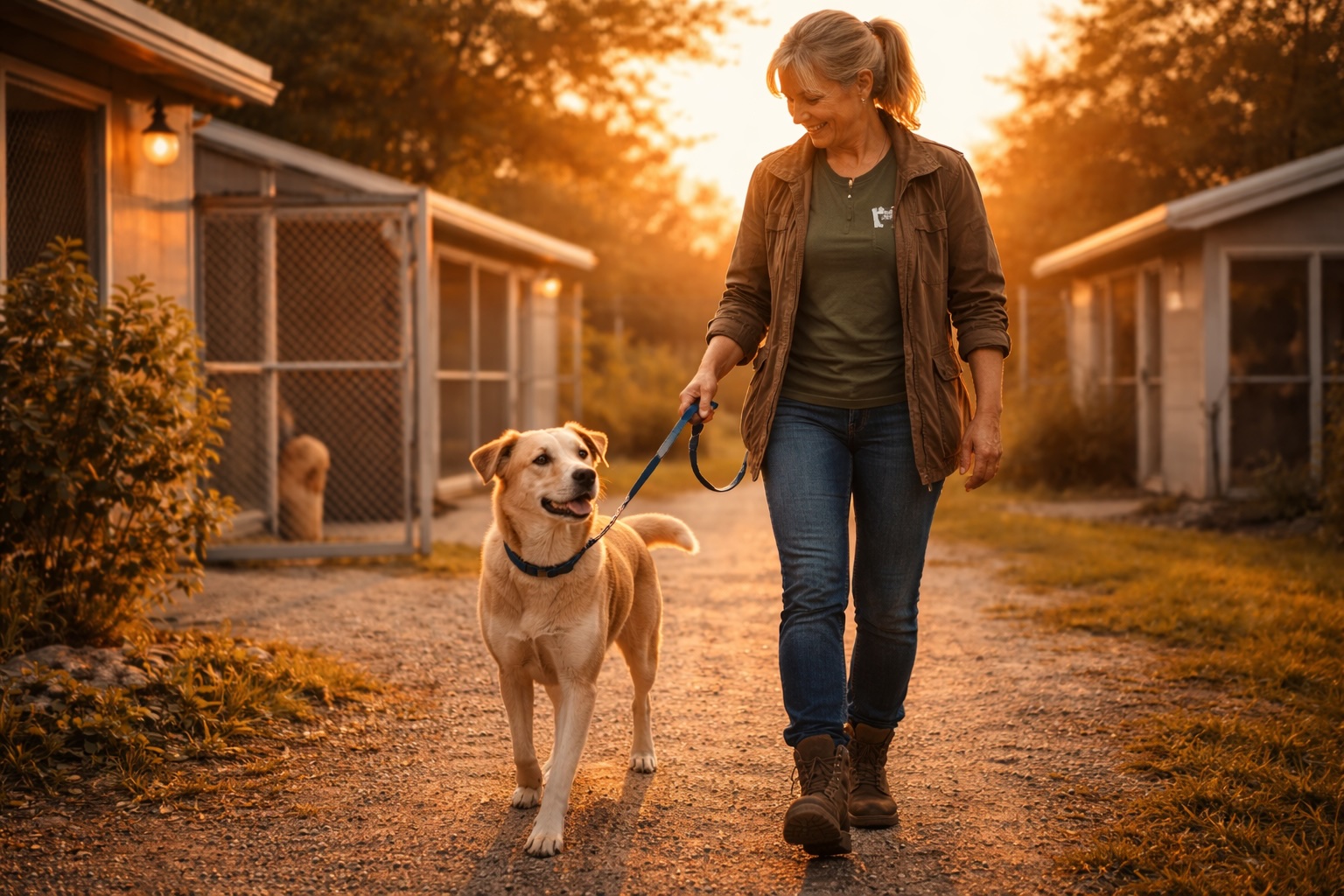
The daily work of volunteering can be plain and unglamorous, but that is part of its value. You may start the morning cleaning kennels while dogs bark hard enough to rattle your chest. You may spend time preparing enrichment toys, laundering bedding, or helping staff move animals for medical checks. Then, if the shelter allows dog handling, you may walk dogs, sit with shy ones, assist with basic socialization, or support adoption meet-and-greets.
These tasks matter because dogs live in the details. A clean resting area lowers stress. A proper walk helps release energy. A patient interaction can improve adoptability. Even simple routines, repeated with care, help dogs feel safer. For the volunteer, those routines build discipline and consistency. You learn that care is often made of small acts done well, not grand gestures done once.
And there is another truth to it. You begin to understand how much effort responsible dog ownership really takes. Feeding, cleaning, exercise, training, vet care, observation, and emotional steadiness are not optional. They are the work. Anyone considering a companion dog, therapy dog, or service dog should understand that early, and shelter volunteering offers a clear-eyed view of it.
Emotional Rewards and Hard Realities
There is no use painting it prettier than it is. Animal shelter volunteering can fill your heart and wring it out in the same week. Some dogs blossom and get adopted into good homes. Some arrive in rough shape and need time. Some stories stay with you. If you are soft-hearted, and most true dog people are, the hard cases can ride home with you in your thoughts.
Still, there is something deeply grounding about doing useful work where it counts. You may be the first calm hand a dog has felt in days. You may be the one who notices a behavior pattern that helps staff place that dog in the right home. You may simply be the person who gives a lonely animal ten quiet minutes in the sun. That matters more than many people realize.
For future owners and handlers, these emotional lessons are important too. Dogs are not accessories. They are living beings with needs, limits, and histories. Volunteering burns that truth into your understanding in a way no sales page ever will.
How to Start Volunteering at a Local Animal Shelter
Most shelters have an application process, an orientation, and rules about age, handling experience, and scheduling. Some need volunteers for direct dog care, while others need help with cleaning, admin work, transport, or adoption events. If your goal is to learn more about dogs, especially those suited to companionship or working roles, be honest about that. Staff members usually appreciate volunteers who show up ready to learn and willing to help with whatever is needed.
Start with an open mind. The glamorous parts come second. Reliability comes first. Show up when you say you will. Listen to staff. Follow handling protocols. Respect each dog’s limits. In time, you will likely earn more responsibility and more chances to work closely with the animals. That is where your education really begins.
Why This Experience Helps Future Dog Owners Make Better Choices
One of the biggest mistakes people make when choosing a dog is shopping with their eyes before they use their judgment. In a shelter, that habit fades quickly. You learn to value recovery, steadiness, tolerance, and connection over flash. You begin to understand that the best dog for your life may not be the most dramatic one in the room. It may be the one that checks in with you, settles after exercise, accepts handling, and shows a steady mind.
That perspective is especially useful for people exploring therapy dogs, service dogs, or dependable household companions. Volunteering gives you a stronger sense of what traits can be nurtured and what traits need careful consideration. It also teaches respect for training. Even a naturally promising dog needs structure, repetition, and guidance. There are no shortcuts worth taking.
In the end, volunteering at a local animal shelter is not just about helping dogs, though that alone is reason enough. It is also about becoming the kind of person a good dog can rely on. You learn to pay attention, to stay steady, and to work without needing applause. Those qualities matter in the kennel, in the home, and anywhere a dog is asked to trust a human being.
If you are curious about companion dogs, therapy dogs, or service dogs, and you want knowledge that has some dirt on its boots, go volunteer. Walk the rows. Listen more than you talk. Watch how dogs respond to structure, patience, and kindness. You will come away with sore feet, a fuller heart, and a truer understanding of what dogs need from us. That is the kind of education that sticks.
I have spent enough time around working animals to know that you do not really understand one until you have seen it under pressure. Hunters learn that in the field. Shelter volunteers learn it in the quiet minutes too, like when a dog finally settles after pacing in circles, or when one wary hound decides your hand is safe enough to sniff. Those moments teach patience, timing, and observation. They also teach humility. A dog is not a machine, and the best handlers are the ones who learn to read what is in front of them instead of forcing what they hoped to see.
For anyone thinking about bringing home a dog, especially one that may someday serve as a steady companion, a therapy dog, or even a service dog prospect, volunteering gives you practical insight that books rarely capture. You begin to recognize how routine shapes confidence, how stress changes behavior, and how the right human can turn a shut-down dog into one ready to trust again.
Why Animal Shelter Volunteering Matters
At first glance, volunteering at an animal shelter looks simple. Walk dogs, refill water bowls, clean runs, fold blankets, maybe help at adoption events. But underneath those tasks is a bigger lesson. Shelters operate at the crossroads of behavior, health, environment, and human expectation. One dog may be bouncing off the kennel door from pent-up energy. Another may curl into the back corner and avoid eye contact. A third may lean into you with the kind of softness that tells you it once had a home and still remembers the rhythm of one.
That range matters. If your interest is in therapy dogs, service dogs, or dependable family companions, exposure to many different dogs helps sharpen your eye. You start to notice recovery time after stress, willingness to engage, sensitivity to noise, sociability with strangers, and adaptability to handling. These are not small things. They are often the very traits that influence whether a dog will thrive in a busy home, a hospital visitation setting, or the structured world of service work.
Shelter work also reminds people that breed alone does not write the whole story. Background, socialization, health, environment, and daily handling all leave their mark. That is important for anyone trying to choose the right dog. A label on a kennel card can give you a clue, but the dog itself tells the real tale.
Learning Temperament Through Real Experience
One of the finest things a volunteer gains is an eye for temperament. Not the romantic version, but the honest kind. You learn to tell the difference between a dog that is truly calm and one that is simply shut down. You learn that a wagging tail is not always a sign of ease, and that stillness can mean thoughtfulness in one dog and fear in another. This kind of knowledge pays off for future dog owners, especially those seeking a stable companion dog or evaluating potential therapy dog qualities.
I have seen dogs step out of a kennel wild-eyed and pulling like a sled team, only to settle into a clean, responsive walk after ten minutes of patient handling. I have also seen sweet-looking dogs fold under pressure from noise or traffic. Neither observation is a judgment. It is information. The more of it you gather, the better prepared you are to make wise decisions about training, adoption, and long-term fit.
How Volunteering Helps You Understand Different Dog Roles
Not every shelter dog is suited for every purpose, and volunteering makes that plain in a hurry. A good companion dog needs stability, a manageable energy level for its household, and a bond with its people. A therapy dog usually needs confidence around strangers, comfort with touch, and an easygoing nature in unpredictable settings. A service dog prospect often requires an even more exact set of traits, including focus, resilience, trainability, and the ability to recover quickly from distractions.
When you volunteer, you begin to see how these traits show themselves in everyday interactions. A dog that seeks connection without becoming frantic may make a lovely companion. A dog that leans into gentle petting and remains composed around new people may have therapy dog potential. A dog that checks in naturally, adapts quickly, and works through novel environments without falling apart may hint at traits people value in service dog candidates. Shelter volunteering will not certify any dog for these roles, but it teaches you what to look for and, just as important, what to question.
That kind of practical understanding is worth its weight in gold for families, first-time adopters, and anyone researching working or support roles for dogs. It replaces fantasy with observation, and that is always a fair trade.
The Shelter Teaches Patience Better Than Any Manual
There is a saying among outdoorsmen that the woods will expose your impatience faster than any man ever could. The shelter does the same. You cannot rush trust. You cannot force confidence into a frightened dog. You cannot demand calm from an animal whose body has been flooded with stress for days. Volunteering teaches you to slow down, adjust your energy, and let the dog meet you halfway.
That lesson carries straight into life with companion, therapy, and service dogs. Good handling is rarely loud. It is consistent, observant, and fair. The volunteer who learns to clip a leash quietly on a nervous dog, guide it through a hallway without adding pressure, and reward even the smallest sign of relaxation is learning skills that matter far beyond the shelter walls.
What You Actually Do as a Shelter Volunteer
The daily work of volunteering can be plain and unglamorous, but that is part of its value. You may start the morning cleaning kennels while dogs bark hard enough to rattle your chest. You may spend time preparing enrichment toys, laundering bedding, or helping staff move animals for medical checks. Then, if the shelter allows dog handling, you may walk dogs, sit with shy ones, assist with basic socialization, or support adoption meet-and-greets.
These tasks matter because dogs live in the details. A clean resting area lowers stress. A proper walk helps release energy. A patient interaction can improve adoptability. Even simple routines, repeated with care, help dogs feel safer. For the volunteer, those routines build discipline and consistency. You learn that care is often made of small acts done well, not grand gestures done once.
And there is another truth to it. You begin to understand how much effort responsible dog ownership really takes. Feeding, cleaning, exercise, training, vet care, observation, and emotional steadiness are not optional. They are the work. Anyone considering a companion dog, therapy dog, or service dog should understand that early, and shelter volunteering offers a clear-eyed view of it.
Emotional Rewards and Hard Realities
There is no use painting it prettier than it is. Animal shelter volunteering can fill your heart and wring it out in the same week. Some dogs blossom and get adopted into good homes. Some arrive in rough shape and need time. Some stories stay with you. If you are soft-hearted, and most true dog people are, the hard cases can ride home with you in your thoughts.
Still, there is something deeply grounding about doing useful work where it counts. You may be the first calm hand a dog has felt in days. You may be the one who notices a behavior pattern that helps staff place that dog in the right home. You may simply be the person who gives a lonely animal ten quiet minutes in the sun. That matters more than many people realize.
For future owners and handlers, these emotional lessons are important too. Dogs are not accessories. They are living beings with needs, limits, and histories. Volunteering burns that truth into your understanding in a way no sales page ever will.
How to Start Volunteering at a Local Animal Shelter
Most shelters have an application process, an orientation, and rules about age, handling experience, and scheduling. Some need volunteers for direct dog care, while others need help with cleaning, admin work, transport, or adoption events. If your goal is to learn more about dogs, especially those suited to companionship or working roles, be honest about that. Staff members usually appreciate volunteers who show up ready to learn and willing to help with whatever is needed.
Start with an open mind. The glamorous parts come second. Reliability comes first. Show up when you say you will. Listen to staff. Follow handling protocols. Respect each dog’s limits. In time, you will likely earn more responsibility and more chances to work closely with the animals. That is where your education really begins.
Why This Experience Helps Future Dog Owners Make Better Choices
One of the biggest mistakes people make when choosing a dog is shopping with their eyes before they use their judgment. In a shelter, that habit fades quickly. You learn to value recovery, steadiness, tolerance, and connection over flash. You begin to understand that the best dog for your life may not be the most dramatic one in the room. It may be the one that checks in with you, settles after exercise, accepts handling, and shows a steady mind.
That perspective is especially useful for people exploring therapy dogs, service dogs, or dependable household companions. Volunteering gives you a stronger sense of what traits can be nurtured and what traits need careful consideration. It also teaches respect for training. Even a naturally promising dog needs structure, repetition, and guidance. There are no shortcuts worth taking.
In the end, volunteering at a local animal shelter is not just about helping dogs, though that alone is reason enough. It is also about becoming the kind of person a good dog can rely on. You learn to pay attention, to stay steady, and to work without needing applause. Those qualities matter in the kennel, in the home, and anywhere a dog is asked to trust a human being.
If you are curious about companion dogs, therapy dogs, or service dogs, and you want knowledge that has some dirt on its boots, go volunteer. Walk the rows. Listen more than you talk. Watch how dogs respond to structure, patience, and kindness. You will come away with sore feet, a fuller heart, and a truer understanding of what dogs need from us. That is the kind of education that sticks.



View all 0 comments